Does Wisdom Really Come with Age?

I finally finished reading a book that took me several months to read, partly because it was one of those intellectual books where you read a paragraph or two, and stop and think, What the heck did I just read? But the parts I actually did comprehend were very insightful and thought-provoking. I participated in a small group book study organized by a young-adult’s group I attend, and it focused on relationships — those with our peers, and eventually that with a significant other. Our book referenced numerous times points made in Love & Responsibility written by Karol Wojtla (a.k.a. Pope John Paul II), so I chose to further my study by delving into the genius that is JPII.

While the scope of Wojtlya’s work is largely focused on married persons, I found much of it relevant to simply “loving thy neighbor.” He writes that as a human being, “it is rightly due to the person to be treated as an object of love, and not an object of use” (26). This seems like such a foreign concept in our “culture of use” we live in today; our society encourages individuals to get ahead using any means necessary, including other people. Our valuation of the human person has dropped significantly, hence why we have a whole month dedicated to respecting human life. But the littlest among us oftentimes are the model of love and total faith that we ought to strive for.

In Matthew 18:3-4, Jesus says “Amen I say to you, unless you turn and become like children, you will not enter the kingdom of heaven. Whoever humbles himself like this child is the greatest in the kingdom of heaven.” Children are largely dependent individuals, placing their trust and faith in those who have been charged with their well-being. Hence why Jesus says we should become like these children, and put our faith and trust in him to provide for us. Sometimes as adults though we think that we are above such “childish neediness”, that we are smart enough to handle everything on our own. But I believe that we can learn a lot about being an “object of [God’s] love” that Wojtlya writes about by watching and listening to children such as these.

Always striving to be the “fun” aunt, I had found a craft for my nieces and nephews to do at one of our family parties. This particular craft involved a lot of small pieces of tissue paper, so a few days before the party I began to cut the paper into what I believed were just the right sized and shaped pieces. Two of my nephews came over during this time and of course had to inquire about what I was doing and if they could help. I tried to brush them off because one, scissors and young kids don’t usually end well together, and two, because I didn’t want pieces of paper that weren’t cut “just right”. I eventually relented and let them cut the crooked and misshaped pieces they wanted. As I sat next to them and saw how happy they were to be helping and excited about seeing their pieces going towards the final project, I realized I was wrong. They didn’t care if the pieces they glued to make their stained-glass window were perfect or not; it became more special to them because they put their hard work into it (holding a “big kid” scissors is hard work for a 3-year old!). I believe God feels the same way about each of our efforts to serve him. If He wanted something done perfectly, he would have no problem doing it himself; but it brings him greater joy watching his children put forth an imperfect effort to bring about beautiful results.

I was reminded of this again as I read Bishop Robert Barron’s gospel reflection on the mustard seed in Chapter 13 of Luke’s gospel. Bishop Barron wrote “it is a commonplace of the Bible that God rejoices in our cooperation. He wants us to involve ourselves — through freedom, intelligence, creativity in what he is doing…God could have rebuilt his church, but he wanted St. Francis to get involved [so he said] ‘Francis, rebuild my church’ “

So if you feel like you could never do enough good to please God, remember that he rejoices simply in your willingness to cooperate in his divine purposes.

I experienced another revelation of God’s love for us while attending mass one Sunday. It was my nephew’s very first time being a mass server, and I smiled as he practically ran towards the rectory in excitement. Just for the point of this story, you need to know that I was sitting with my older brother and his newborn daughter while my younger brother was in the back being an usher. As the time to start mass was getting closer, our priest and my nephew came to the back of church for the procession, and it was evident the other scheduled server had not shown up. Now, my younger brother was still of mass-serving age, so he would have been able to help our nephew; but that would have required my older brother to take his place as usher, and I would have had to watch my little sleeping niece (tough gig I know!). Thankfully another server came at the last minute, so we didn’t have to worry about it, but it got me thinking that we all would have jumped in to do our parts to help our nephew because he’s family, he’s one of us.

The same would go for God; we are each his children, a member of his family, so there is no limit to the lengths he would go to help us. How many times does God mention in the Bible about taking care of widows and orphans? Or the phrase that’s mentioned 365 times throughout the Bible: “Be not afraid.” God will be there with us so we need not fear. There are countless examples throughout scripture, such as Deuteronomy 33:12-13 “the beloved of the Lord, he abides in safety beside him; he shelters him all day long” or Joshua 1:9 “I command you: be strong and steadfast! Do not fear nor be dismayed, for the Lord, your God, is with you wherever you go.”

The Bible is filled with all of the promises God makes to us as his beloved children; there is no limit to his love and mercy. Evidence of this is all around us; even the littlest among us can teach us of God’s perfect love of our imperfect selves.

I Love Cinnamon Rolls!

Happy New Year!

During 2020, the over-zealous introvert that I am took advantage of the curfews and stay at home orders; I have completed a stack of books, along with the occasional cup of coffee or glass of wine. My list of books ranged from St. Augustine to a McDonald’s franchisee who writes of keeping his Catholic-minded principles in today’s business world. This businessman, by the name of John Abbate, wrote in Invest Yourself, that “the true beauty of the Catholic faith can be fully realized only when we utilize our intellect to acquire knowledge to grow in our faith” (5). This is what motivates me every time I select a book, video, podcast, whatever it is that can help to fully realize my Catholic faith. As I have continued my own endeavor to strengthen my relationship with God, I have realized that the more we seek to find God, the more we actually find ourselves. I believe there is a confidence that comes with knowing and truly believing that I am a child of God, and that God created me specifically to be the unique individual that I am. And He has done the exact same for each of you.

As I continue to learn about my Catholic faith and build on the foundation of being a member of God’s church, I have found myself going places and doing things that I once would have said were totally out of my comfort zone. But, the more we find ourselves and the more we open ourselves up to God, the more we can see how He uses us for His divine plans.

2020 left us with a myriad of emotions: from fear to loss, from frustration to disappointment, but also wisdom, hope and perhaps even a deeper amount of faith. For me, 2020 has taught me a lot of hard lessons, which also helped me gain a deeper insight into life in general; for example, finding new ways to console friends or family when being physically present is not an option; or directing me to look to those great saints who have come before us, like St. John Paul II, who have faced numerous hardships themselves. and how they placed total trust in God to help them face their trials.

So, as 2020 has come to a conclusion, it is imperative that we take what this historical year has taught us, and move forward determined to not live with the same tribulations in 2021. The wounds of our world are not going to be mended simply by the turning of the calendar, they can only be reconciled if we turn back to the ultimate healer.

For my long New Year’s weekend this year I did something that was (wait for it) totally out of my comfort zone. Two of my friends and I went to a Catholic young adult conference. Now, while the vocal outbursts and charismatic worship (cue the grown man on the floor rocking back and forth in the fetal position) was an overwhelmingly new experience for me, there was a profound feeling in knowing that all of these individuals, from thirty-one different states even, came together because we all have a desire to seek Jesus. Even further, as young adults, each of us there recognized how our generation and our pleasure-seeking culture today is losing sight of Jesus, even just faith in general, and we are not okay with that. St. John Paul II recognized this issue long before we did when he said that “you are right to be disappointed with hollow entertainment and passing fads, and with aiming at too little in life” (Evert 93). This conference was entitled Empower because it set out to equip us to bring this world back to God.

As one of the leaders said, “If I love the cinnamon roll I had for breakfast, I’m going to tell people about it so they can enjoy it too. The same should go for Jesus.”

I sat there listening to that message and I asked myself why I do not tell others about loving Jesus as much as loving a cinnamon roll, and the main reason I came up with was fear. Fear of what others will think of me “preaching” about my faith. And then I remembered this breakthrough (it was for me at least) conclusion I reached recently: I should not be concerned about what total strangers or people that will not be a part of my life in five years think of me. I should only be concerned about what God thinks of me, because someday I am going to be answering to Him, not to the people I have wasted my time trying to appease and conform to.

One of the best speakers at the conference (at least in my opinion) said that “Jesus is the longest relationship we will have in our lives.” As that statement sank in, I realized that I had a lot of work to do with that relationship. Which is the reason this speaker, whose name is Noah, was speaking on discipleship. He shared with us the three foundations of discipleship: lifestyle, death and love. Lifestyle because he says it is your life, not your knowledge that will transform those around you, death because Jesus said we need to take up our respective crosses and follow Him, which is essentially dying to ourselves (or our preferences), and finally, love, because all things must be done in love. But he also said that in order to accomplish all of this, we must first be in love with the one who first loved us. So, am I willing to risk a little awkwardness in an encounter with someone else to express how much the love of Jesus means in my life? Are you?

To be honest, I was a little apprehensive about just asking my friends to go to this conference with me because I did not want them to think I was some uber-religious fanatic; but I eventually mustered up the courage and I feel that our friendship grew stronger over that weekend. We really opened ourselves up and let Jesus enter into our relationship; we had real conversations that went deeper than our usual catching up conversations of work and social activities. It reminded me that when you open yourself up to allowing God into your life and letting Him direct you for His purposes, great things can happen. Maybe I did not have some mind-blowing breakthrough moment at the conference, but it was worth going because my friends each had a private experience that was meaningful to them, and they were grateful I had asked them to go.

So, here is a challenge for you, and for myself too, that we will go out and take the opportunities that are presented to us to reject the pleasure-seeking, morally inept “norms” that we are surrounded by and proclaim Jesus back into our world. Because, as they told us at the conference, when the church fails, the world fails.

Love Thy Neighbor

I have struggled writing this entry, and it has taken me more than one draft to get the right words out. At the time of my first draft, the effects of the corona virus pandemic were just beginning to reach Ohio; schools closed, churches closed, my work even eventually closed. It seemed that these minor inconveniences were the only effect the pandemic would have on myself and my family; but soon the ground we were standing on seemed to crumble right underneath us. Both of my dad’s parents somehow contracted the virus, even though they had been abiding by the stay at home orders. The update I was writing in my first draft detailed how my grandma was quarantined and recovering at home while my grandpa was in a hospital a few hours away on a ventilator, but was doing okay.

I could not bring myself to finish that draft because a few days later, my aunt received a call in the middle of the night from the hospital to inform the family that Grandpa’s heart rate had drastically fallen and the doctors expected him to crash at anytime. He made it through that morning and kept hanging on; the following days were rather harrowing, a lump would form in my throat every time the phone rang because it could be THE call. Our families were able to video call into my grandpa’s room to tell him that we loved him, though we were unsure if he could even hear us through the sedation and his coughing and moaning.

But, by the end of that week, my grandpa was still here, still fighting through this awful virus. The doctors then decided to change course and take him out of sedation to see what would happen. The next day, which just happened to be Divine Mercy Sunday, the nurses told us they went into his room and he was sitting up in his bed praying a Hail Mary. Everyone, the doctors, nurses, our family, were just astounded; the doctors had all but given up on my grandpa, but God hadn’t! Now, at the time of this writing, Grandpa is in a nursing home a lot closer to home recovering until he gets a negative Covid test result, then he will be headed home after more than a month!

During those tumultuous days, I kept re-reading a few quotes I had highlighted from the book I had read for this post. I received the book, Saint John Paul the Great: His Five Loves by Jason Evert, from one of my high school classmates. He gave a talk several months ago, when you could still do such things ;), before he left for a seminary in Colorado. He talked of his love for Pope Saint John Paul II, and he gave out these books so we could discover this great modern-day saint as well.

Prior to reading this book, I did not know much about Pope John Paul II, I was only about ten years old at the time of his death. I was quite astounded reading about his upbringing and his journey to the papacy. By the time Karol was in his early twenties, he had already lost his mother, his only brother, and then his father. He had survived the Nazi occupation of Poland only to succumb to the rule of Communism. I was fascinated to learn that Karol was so well read on the principles of Marxism that the Communists deemed him a threat because he understood their system better than they did. But he only used his gift of intelligence to further God’s kingdom, not for any political ploys.

Karol loved spending time with young people; he was described as an “eternal teenager” by a fellow priest because he was “never happier than when working with young people” (86). He could listen for hours as teenagers or college students would tell him about issues they were facing or ask him questions. He ministered to them in such a way to help them find their answers. He once said that “the more the world deprives young people of what is true, good and beautiful, the more earnestly will they yearn for it” (92). His life work was to lead succeeding generations to the unwavering truth he had found himself: Jesus.

I found it interesting that as a priest, and even as a bishop and cardinal, Karol enjoyed taking groups of young people camping, hiking or skiing, as retreats to minister to them. So great was his love for skiing that, even as pope, he was spotted on the slopes on more than one occasion trying to ski incognito!

One of Pope Saint John Paul’s other loves as described by Evert is that of human love. Though the words that John Paul spoke are from a different time, I believe they are more than fitting to today’s world; “genuine love … is demanding. But it’s beauty lies precisely in the demands it makes” (99). Also, ” we must never forget that only when love between human beings is put to the test can its true value be seen” (105). I think we could all agree that during these Covid-anxiety induced days, we are all being put to the test. But, perhaps it is these very days that we will find precisely the love that the great pope was speaking of. Even after all of the turmoil of his youth, Karol, and later as Pope John Paul, displayed the love and mercy of Jesus Christ, even to people like his would-be assassin. We are still called, especially in trying times such as these, to do the same.

As I pondered these words these past few weeks, I began to see evidence of this love: people who did not personally know my grandpa were praying for his health, family meetings where individuals put their differences and opinions aside to come together for a common goal, even just a gesture as simple as sending a homemade meal. Now, these instances are all on the small scale of my family, my community, but examples like these are happening all over the world right now. Out of the love of our fellow neighbor, we are all putting differences aside and coming together to fight this invisible war. And God-willing, when this is finally over, I believe we will see the beauty of genuine love.

“Let us go forth full of trust in Christ. He will accompany us as we journey toward the goal that He alone knows” (210).

Real Ownership

During my senior year of college, I was introduced to Dave Ramsey and his teachings for reaching financial peace. I now enjoy listening to his podcasts and I have recently started reading his books. Having a degree in business and having taken several financial courses, I would have to say that Dave Ramsey teaches how to win with money and understand all of that crazy financial jargon better than any professor I had.

That being said, I like his methods even more for the biblical and ethical motivations behind them. He stresses that God is the real owner of our money, and that God has entrusted each of us with a share of His wealth. We are called to be responsible “managers” for God, and to use His money in ways that are pleasing and glorifying to Him.

Our culture today seems to have gotten so caught up in money and material possessions, which can lead to the argument that money is evil and those blessed with a surplus of it are greedy. But we, as followers of Christ, are taught that money itself is not evil, but rather the love of money is. If money is put high on our priority list, then money is coming before God. But, if we keep in mind that God is the real owner of our wealth, it shifts our perspective of our priorities.

Dave Ramsey explains this in greater detail in his book The Legacy Journey. He advises that we should learn how to properly manage money God’s way instead of society’s way. By setting this example, when wealth is left to succeeding generations, it becomes a blessing, not a disaster.

I was really intrigued reading this book, because I couldn’t recall ever being presented with the concept of God being the true owner of our wealth. I got to thinking though, that this could apply to countless other facets of our lives, which led me to thinking about 1 Corinthians 6:19 Do you not know that your body is a temple of the holy spirit within you, whom you have from God, and that you are not your own? For you have been purchased at a price. Therefore, glorify God in your body.

I used to never exercise regularly; I would maybe do a Pilates workout for two weeks and then I would lose motivation and not do anything for a while. Then, a few years ago I started running (thanks Aunt Jane!); then I added strength and cross training to help with my running. Now I enjoy exercising regularly, and I even started noticing this sort of spiritual connection with God forming during my workouts. Taking care of my body, and realizing the amazing athletic things it can do that I doubted it ever could do (like completing a half marathon), I believe is being a good manager for this gift God has entrusted me with. I use this gift and offer up my runs and workouts so that completing them can glorify God because I know He helped me through each challenge.

This concept can apply to countless other aspects of our lives: friendships, children, any special talents a person may have, and the list can go on. They are all gifts bestowed to us by God, and we are called to be His good stewards by taking care of these gifts and using them in ways that show His glory.

What matters is being grateful for what we’re given, taking responsibility for it, and then managing it well. – Dave Ramsey (pg. 43)

Jesus Needs You Too

If you’ve made the decision to place your full trust in Jesus and to deepen your relationship with our Heavenly Father and His son, Consoling the Heart of Jesus can help with this as well. As much as each of us needs Jesus in our daily lives, Father Gaitley explains that Jesus needs us too. His heart is stricken with pain and grief over the lost individuals of this world that do not know His mercy and love. But we, as believers and followers of Christ, can alleviate some of His monumental burden. Now, this may seem like an impossible task: How on Earth can I, a single, small individual ease the pain of the Son of God? Have no fear for Fr. Gaitley explains just how simple it really is.

In the first appendix of his book, Gaitley acquaints the reader with St. Ignatius of Loyola’s “Rules for the Discernment of Spirits.” These were Ignatius’s tools for conquering his battle for spiritual joy, and they are still just as relevant today for our use in overcoming our spiritual struggles to find joy. Essentially, it states that “if we simply accept [Jesus’s] love and care, then this brings peace and joy, which overflows into praise and thanks, which as we know, is the trust that greatly consoles Him” (251). Just simply allowing Jesus into our lives and receiving God’s love and mercy is consoling to Him; He thoroughly wants to hear from us and have a relationship with us. Jesus is uplifted when we share with him even the smallest details or worries or troubles of our day. There is no matter that is too small for the Son of God to be concerned with. Having a closer relationship with Jesus greatly benefits us as well, because who doesn’t need a little Jesus sprinkled in their day!

After accepting Jesus’s love and mercy for us, we can still console him more by sharing this love and compassion with others too. This previous lenten season, I signed up for Dynamic Catholic’s “Best Lent Ever” program. It was a series of daily videos going along with Matthew Kelly’s book The Biggest Lie in the History of Christianity. In it, Kelly introduces his concept of the “holy moment.” He describes it as “a moment when you are being the person God created you to be, and you are doing what you believe God is calling you to do in that moment” (36). Essentially, it is when you are responding to a situation, good or bad, and you stop to think “what would Jesus do?”

If Jesus woke up to a beautiful sunrise, He would stop to thank God for a new day full of wondrous beauty. If Jesus was driving down the highway and someone cut him off in traffic, he would not get angry. Rather, he would stop to say a prayer for the other driver. If Jesus was walking out of the grocery store and saw an elderly woman struggling with her bags, he would go to her and help her carry them to her car. These are all holy moments, and these are all things you and I can do each and everyday.

Now, I understand that not every situation we encounter in our daily lives will be this simple to act in accordance with what God wants us to do, but we have to start somewhere. Matthew Kelly writes that “our mere openness to doing the will of God is pleasing to Him” (39). Just stopping to think before reacting to consider what would be the holiest response is a step in the right direction. And, it is pleasing to God and consoling to Jesus. If you let God into your life and strive to create holy moments, just imagine how wonderfully He can change your life.

Jesus gave up His life so that you and I could have ours; working to be who God calls us to be, and letting Him into our hearts and minds is the least we can do in return. Extending our God-given graces to others, even if we personally feel they are not entirely deserving of it, will merit us countless rewards. As St. Faustina describes, “you lose nothing but gain much” (284). That warm and fuzzy feeling you get when you do something nice for someone without expecting anything in return, that is God letting you know you created a holy moment and shared His love.

So, since we have nothing to lose, let’s set out to console the bleeding heart of Jesus and fill this world with holy moments; letting God into your life is a very good place to start.

The Determination of God and a 3-Year-Old

I just recently finished reading Consoling the Heart of Jesus, a “weekend” retreat based on the Spiritual Exercises of St. Ignatius. Let’s just say it took me a lot longer than a weekend to complete, but it was pretty powerful nonetheless. I closed the book with a deeper understanding of the importance of a close relationship with Jesus, and why He actually needs me too.

In this book, Father Michael Gaitley writes several times that Jesus longs for us to know that “all I want is for you to be my friend. all I want is for you to not be afraid of me and to come to me” (165). Sounds easy enough right? Yet, many of us, myself included, do not always let Jesus in on our struggles, emotions, even our joys. But why? Why is it so hard to just simply accept God’s love and mercy towards us? Maybe we think that we can face and overcome obstacles on our own, and don’t acknowledge that God and Jesus are walking right beside us, sharing this burden with us.

Over and over, God presents us with opportunities to accept His divine mercy, even if we have said no before. I thought about this a few weeks ago as I was watching my three-year-old nephew playing outside. He was playing with my old Little Tikes toy that sprung a plastic baseball into the air at the push of a button. Numerous times he would swing his bat, and though he did hit quite a few, many times he missed the ball. Despite these setbacks, his determination amazed me. He would run around the yard collecting the scattered baseballs, proclaiming to me that he was going to try again. I made a parallel between his unfading determination to hit a baseball to God’s inviting us into His loving embraces; neither would be deterred. That is until the sun began to set and we had to put the baseball game away 😉

The second appendix of Fr. Gaitley’s book is comprised of excerpts from St. Faustina’s diary. She too questioned why it is we do not believe or accept the love of Jesus and his Father. She wrote, “how can He convince us of His love if even His death cannot convince us?” (263). This powerful statement struck a chord with me; it made me evaluate my level of acceptance and trust in Jesus and God’s love and mercy. If God loving me so much made Him send His only son to die for me, why wasn’t I abounding in gratitude and love for Him?

It was time for me to decide for myself to truly accept God’s love and mercy and to place my full trust in Him. Is it time for you to say “yes” too?

You will give Me pleasure if you hand over to Me all your troubles and griefs. I shall heap upon you the treasures of My grace. – Diary of St Faustina (291)

The Wisdom of a Homeless Man

I know you’re supposed to do this the other way around, but I like to do things a little differently. My family and I watched this movie on Netflix and then I read the book of the true story it is based upon. Same Kind of Different as Me is co-authored by Ron Hall and Denver Moore; Hall, a wealthy art dealer, and Moore, a homeless man, are about as likely a pair as a racehorse and a seahorse, but they are a living example of God working in mysterious ways to bring even the unlikeliest of people together to serve Him.

I promise I won’t ruin the book, but I wanted to share a few passages that really stopped me in my tracks and made me evaluate aspects of my own life.

During one scene in the book, Ron and Denver are at a restaurant together and Denver takes notice of the ten or more keys that Ron has looped together on a key chain. He questions if each key belongs to something that Ron owns. When his response is “yes”, Denver inquires, “Are you sure you own them, or does they own you?” (112).

This brings to mind the verse from Matthew’s gospel when Jesus says, “Again I say to you, it is easier for a camel to pass through the eye of a needle than for one who is rich to enter the kingdom of God” (19:24). If we have too many earthly distractions, to the point of them “owning” us, we shift our focus from God to gaining prestige and status from the material world. We devote less time and attention to our relationship with God because other “priorities” have taken ownership of our lives. Ron even admitted that in that moment, the roles in their relationship changed; the homeless man helped the millionaire! Denver claimed he would never want to trade places with Ron, even for a day; his lack of earthly possessions made extra room for God in his life.

In another section of the book, Denver explains a lesson in faith that being homeless and more available to God taught him. He wrote, “Our limitation is God’s opportunity. When you get all the way to the end of your rope and there ain’t nothin’ you can do, that’s when God takes over” (169). Now I don’t know about you, but I’ve been in plenty of situations that I did not know how I would ever make it through them, but literally by the grace of God, I did. God shows us through these instances that He is always there with us, and that when He walks beside us, there is nothing we can’t do. If we trust Him, even in our most vulnerable times, He will see us through any hardship or obstacle.

These few excerpts are just the tip of the iceberg; I would encourage you to read this incredible story. It is teeming with invaluable life lessons; I believe this real life story shows that having more material wealth than someone else does not make you a richer person. Ron Hall gained wisdom from a homeless man that was more valuable to him than the priceless art he sells. Each person we encounter has something worthwhile to teach us if we’d just give him the chance.

“But I found out everybody’s different – the same kind of different as me. We’re all just regular folks walkin’ down the road God done set in front of us” (235).

Practical Ways of Serving God & Keeping Him Present in Your Day

One of the biggest struggles I face is looking for God’s presence throughout my day. His presence is obvious to me at church on Sunday, or when I’m immersed in a book about faith, or listening to a religious podcast while doing work around the house; but it’s harder for me when I am not consciously aware of His wondrous company during my everyday life.

I began to address this issue when I was introduced to the Examen prayer by one of the books I was reading. It involves examining your day and taking notice of the moments when you felt God’s presence. Then you run through your day again, only this time you look at the times you did not feel God’s presence. The final step is to look towards the future and find ways to increase times that God enters your thoughts and awareness throughout the day.

By doing this each night for a week or so, I discovered the areas of my life that were lacking in time spent acknowledging God’s being with me. So I found a few ways to change my outlook on some of my daily activities to incorporate being with God.

When my siblings and I were younger, our mom taught us that when we were doing not so fun chores like pulling weeds or picking green beans in the hot Ohio summer sun, we should offer up our labors to the souls in purgatory, or for someone we knew who was ill.

So I took this concept and worked to apply it to my day. Colossians 3:23 says “Whatever you do, work at it with all your heart, as working for the Lord, not for human masters.” Working for the Lord and offering up my toils to those in need helped me to increase the occasions I spent serving God.

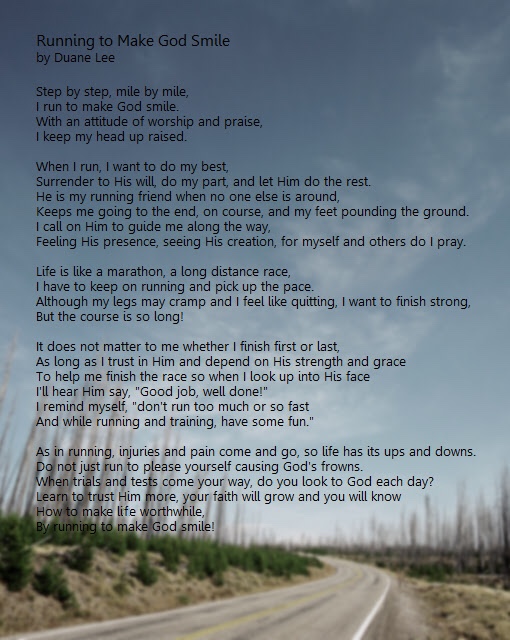
As an avid runner, I found that it was fruitful to include God on my runs as well. With a simple Google search, I found numerous prayers for runners that ask God to be with them in every stride and to serve Him through running. Excluding days below thirty degrees, my co-worker and I try to run a few mornings every week before work, so I began to say a few of these prayers before I would leave to run. My favorite one is “Running to Make God Smile” by Duane Lee. I was excited that something as simple as running, which brings me joy, also brings me closer to God.

There are countless other ways to keep God present in your day to day life, and numerous opportunities to serve Him. The possibilities of making your relationship and servitude toward God are endless. I invite you to practice the Examen for a week and find what areas in your life could use a sprinkle of God thrown in. I mentally and emotionally experienced a change in my life by welcoming God’s companionship into my consciousness outside of church on Sunday, and it is my hope that you can experience this too.

Vocations: Going Beyond Religious Life

After graduating college and settling into a routine of working full time, I began to notice a void becoming ever-more present in my work life. I was just starting to take off on my quest to strengthen my faith, but I felt that for eight hours a day, God was lacking or absent from my life.

Now this is not to say that my workplace is a godless organization because it is really quite the opposite. Everyday I am surrounded by ardent believers of God who serve as shining examples of business leaders with strong ethical foundations.

So, since I did not need a change of scenery to fill this void in my life, I had to keep on searching. Now, I am the type of person who is still constantly trying to learn new things and build upon skills I already possess. Eager to expand on my professional skills, I purchased a book entitled Force for Good: The Catholic Guide to Business Integrity by Brian Engelland, not knowing that it held the first step I needed to take to reshape my work relationship with God.

Early on in the book, Engelland shares a quote from Pope Francis when he addressed the U.S. Congress saying that “Business is a noble vocation” (19). When I read that I was a little surprised and thought, whoa, let’s back this vocation train up; you’re trying to tell me that a career in business is esteemed enough to warrant the same terminology as that of priests and religious life? But, then I thought, who’s going to argue with the Pope? His statement certainly made me sit a little taller in my chair thinking that the Pope deemed my profession “noble!”

Engelland then goes on to explain that Pope Francis was referencing the 2012 Pontifical Council of Justice & Peace, which was a conference of sorts dedicated to the integral relationship between business leaders, ethical business leaders to be more exact, and God’s people. Essentially, good ethical businesses provide the goods and services that sustain us all, but also ethical businesses empower their employees and benefactors to reach their full potentials so they in turn can do the work God is calling them to do.

So, by thinking of my job in the service industry less as a job and more as an opportunity to serve God’s people, I gradually became more aware of God’s presence in my workplace. The daily tasks I performed gained more meaning when viewed in the context of service to God and those around me.

Taking this new mindset, I decided to push myself even further. I challenged myself to view each customer walking through the door of our office as someone whom God loves in the same way that I know He loves me. Well, I guess God got wind of this because He jumped in to help me out; I conversed with someone who directed words toward me that I would have to go to confession for repeating, I struggled to understand how someone would choose to spend his money buying cigarettes and not paying his bills, and I got a lesson in praying for someone who vocally persecuted me instead of harboring ill will towards her. Despite my grumblings about each of these people, God loves them and I have a calling to serve each of them to the best of my ability.

So what about you? How can you shift your mindset to realize how your vocation is calling you to serve God and His people? I learned that you do not have to look far to find God at work in your surroundings and even in yourself. Each person you encounter is worthy of love and he or she just may have a lesson to teach you.